What HDB owners want next is an MRT station, not a prime address
 By Alvin Ang
PropNex polled 1,533 HDB flat owners and found upgrading aspirations alive but budget-bound: 55% still want a private home someday, about 92% have set aside less than $2.5 million for it, and the single most wanted feature in the next home is an MRT station nearby.
The survey, published on 12 August, is one of the better recent windows into how HDB owners actually think about their next move. Some of it confirms what you would expect. Some of it quietly rewrites the standard upgrading story.
The ladder still stands, but the budget is the banister
Just over half of respondents, 55%, aspire to own private housing eventually: 18.3% want a city-fringe (RCR) condo, 15.7% a suburban (OCR) condo, 14.0% a landed home, and only 7.2% a city-centre (CCR) unit.
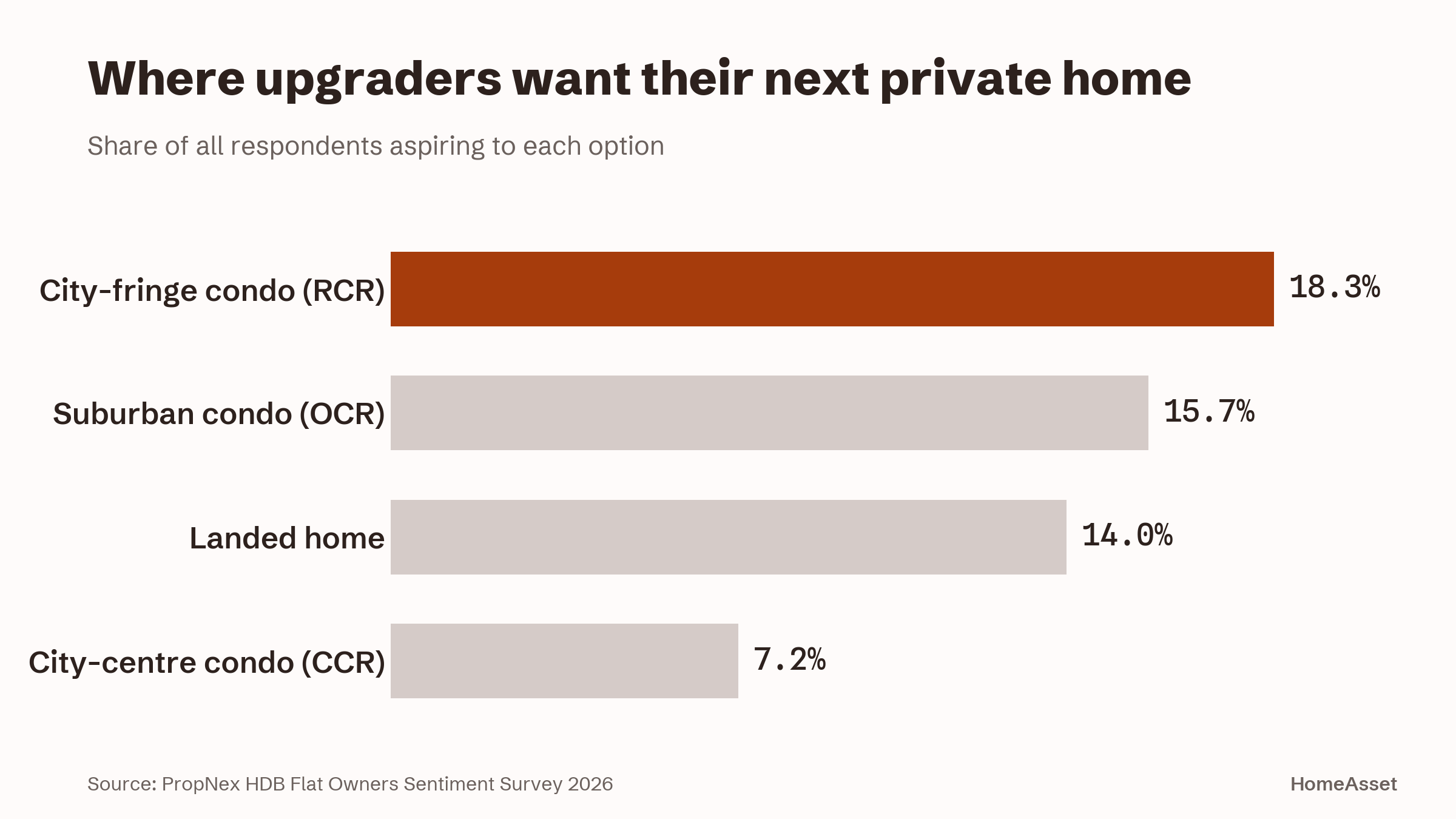 The city fringe has edged ahead of the suburbs as the preferred destination for upgraders. Source: PropNex HDB Flat Owners Sentiment Survey 2026.
That RCR-over-OCR ordering is the surprise. PropNex’s head of research Wong Siew Ying pointed out that the standard assumption has HDB upgraders heading for suburban condos, and reads the city fringe’s lead as buyers seeking a balance between convenience and affordability. She also flagged a perception gap on the city centre: many upgraders assume prime districts are out of reach, yet URA caveat data shows 52.8% of new and resale non-landed homes sold in the CCR in 2025 went for under $2.5 million.
The budgets are specific and tight. The most common band was $1 million to under $1.5 million (30.1% of respondents), with another 29.9% below $1 million. Only 7.9% planned to spend $2.5 million or more. Developer pricing is not far off that reality: URA Realis data cited by PropNex shows 62.2% of new non-landed homes (excluding ECs) sold in the first half of 2026 were priced under $2.5 million.
Convenience beats prestige, and the neighbourhood beats both
Asked to pick the most important attributes of their next home, 77.0% named proximity to an MRT station, bus interchange or transport hub, ahead of reasonable pricing at 67.0% and adequate living space at 41.6%.
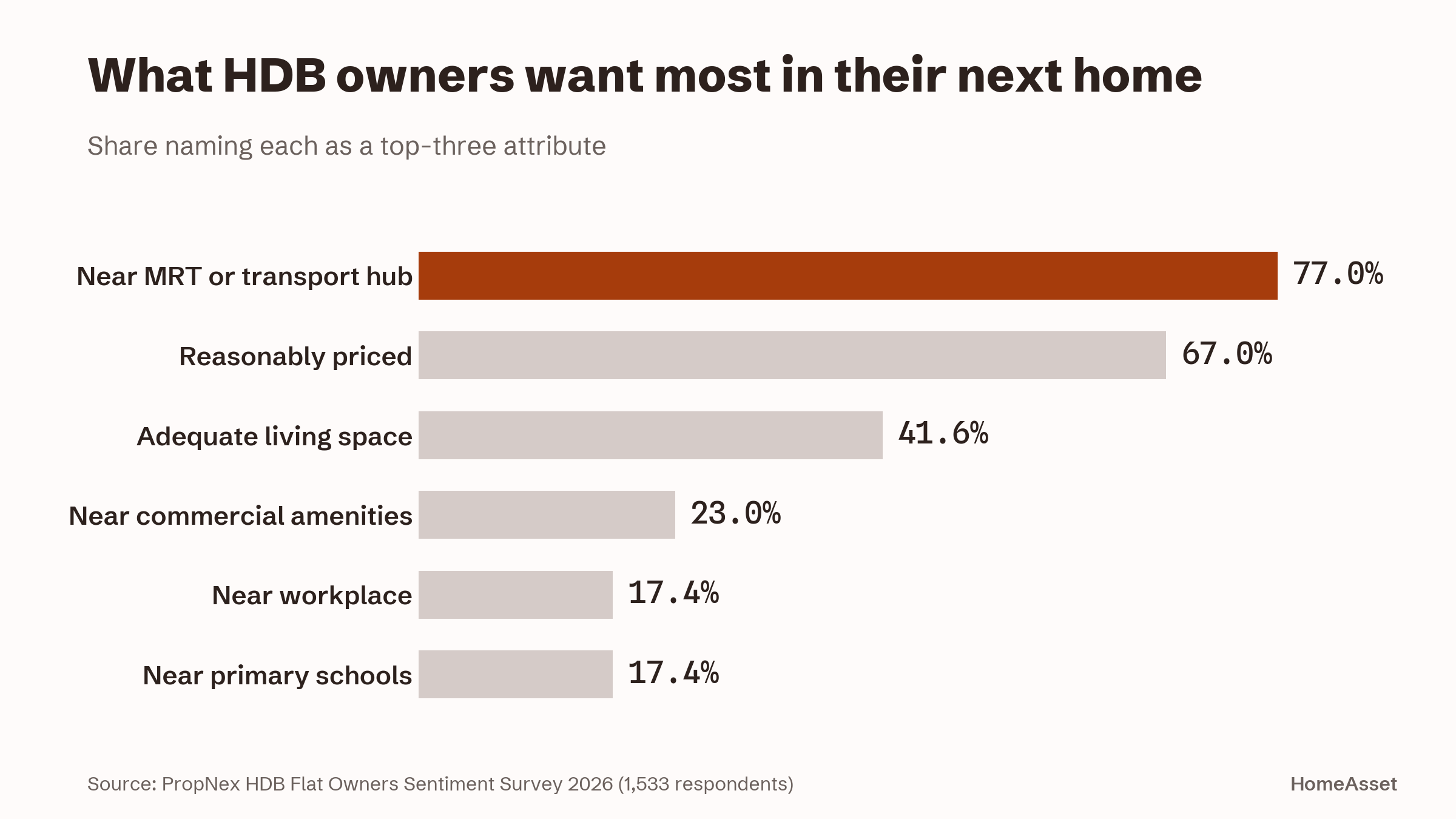 Proximity to an MRT station or transport hub topped every other attribute, including price. Source: PropNex HDB Flat Owners Sentiment Survey 2026 (1,533 respondents).
And when asked where that next home should be, the top answer was not a region at all: 40.6% simply want to stay near where they currently live, in towns like Tampines, Toa Payoh, Punggol and Hougang. Familiarity, schools, parents and routines appear to outweigh any district number.
Contentment runs deeper than the upgrading talk suggests. Some 73.9% of respondents said their current flat adequately meets their needs, essentially unchanged from 2024. High home prices remain the top obstacle to upgrading, cited by 66.3%, up from 63.4% two years ago. The additional buyer’s stamp duty (ABSD, the extra tax on second and subsequent property purchases) has faded as a complaint: 31.2% named it, down from 49.9% in 2024.
The EC maths is changing hands
Executive condominiums, long the classic middle step between flat and condo, drew cooler responses this round. Only 37.7% agreed ECs remain relevant for middle-income private-housing aspirations, down from 44.6% in 2024, and just 10.9% called new EC prices affordable. The median new EC price hit $1,844 per sq ft in the first half of 2026, up from $1,537 in 2024.
The honest part: most EC buyers never intended to stay forever. Only 26.7% would hold an EC long term; the rest plan to rent it out or sell after the minimum occupation period (MOP) or at privatisation. That is exactly the behaviour the government’s 8 May 2026 measures target, doubling the MOP to 10 years and pushing privatisation to 15 for future EC sites. Among the small group of 84 income-eligible respondents polled after the announcement, only 16.7% said they would likely buy an affected EC, and the 10-year MOP was the most cited deterrent. PropNex cautions the sample is too small to lean on, but the direction is hard to miss.
One caveat worth knowing before you quote any of these numbers: respondents were drawn from PropNex’s seminar attendees and digital channels, not randomly sampled, so the findings describe engaged, property-minded owners rather than all of Singapore.
What this means for you
- If you are upgrading on a budget below $2.5 million, you are the market. Developers know most demand sits there, which is why mid-sized units dominate new launches.
- Do not write off the city fringe or even the city centre before checking actual transacted prices. More than half of CCR homes sold in 2025 changed hands below $2.5 million.
- If your plan involves an EC as a stepping stone, run the numbers on the new 10-year MOP first. The old buy-flip-upgrade timeline no longer fits sites sold after 8 May 2026.
- Sellers in mature towns: buyers increasingly want to stay near where they already live and near MRT stations. A well-connected flat in a familiar neighbourhood holds pricing power even in a softening resale market.
Sources
Market commentary dated 14 August 2026. Conditions change; verify figures against the primary sources above before acting. This is general information, not financial advice.