New Bill lowers en bloc consent to 65% for the oldest condos
 By Alvin Ang

Condos aged 40 to 59 would be able to sell en bloc with 70% of owners in agreement, and those 60 and older with just 65%, under a Bill the Ministry of Law introduced in Parliament on 4 August. The current thresholds of 90% and 80% have stood since 1999. In exchange, starting a sale attempt gets harder, and running one gets shorter.
The Land Titles (Strata) (Amendment) Bill 2026 keeps the existing rules for younger projects: 90% consent for developments under 10 years old, 80% for those from 10 to 39 years. The change arrives at year 40, where the bar drops to 70% of owners by share value and number of units, and again at year 60, where it drops to 65%.
MinLaw’s reasoning is about age itself. The consent thresholds were set in 1999, and the buildings have kept getting older since. Many now need heavy spending on maintenance and upgrading to stay safe and liveable, and the ministry wants owners of ageing developments to have a practical path to redevelopment where broad support exists.
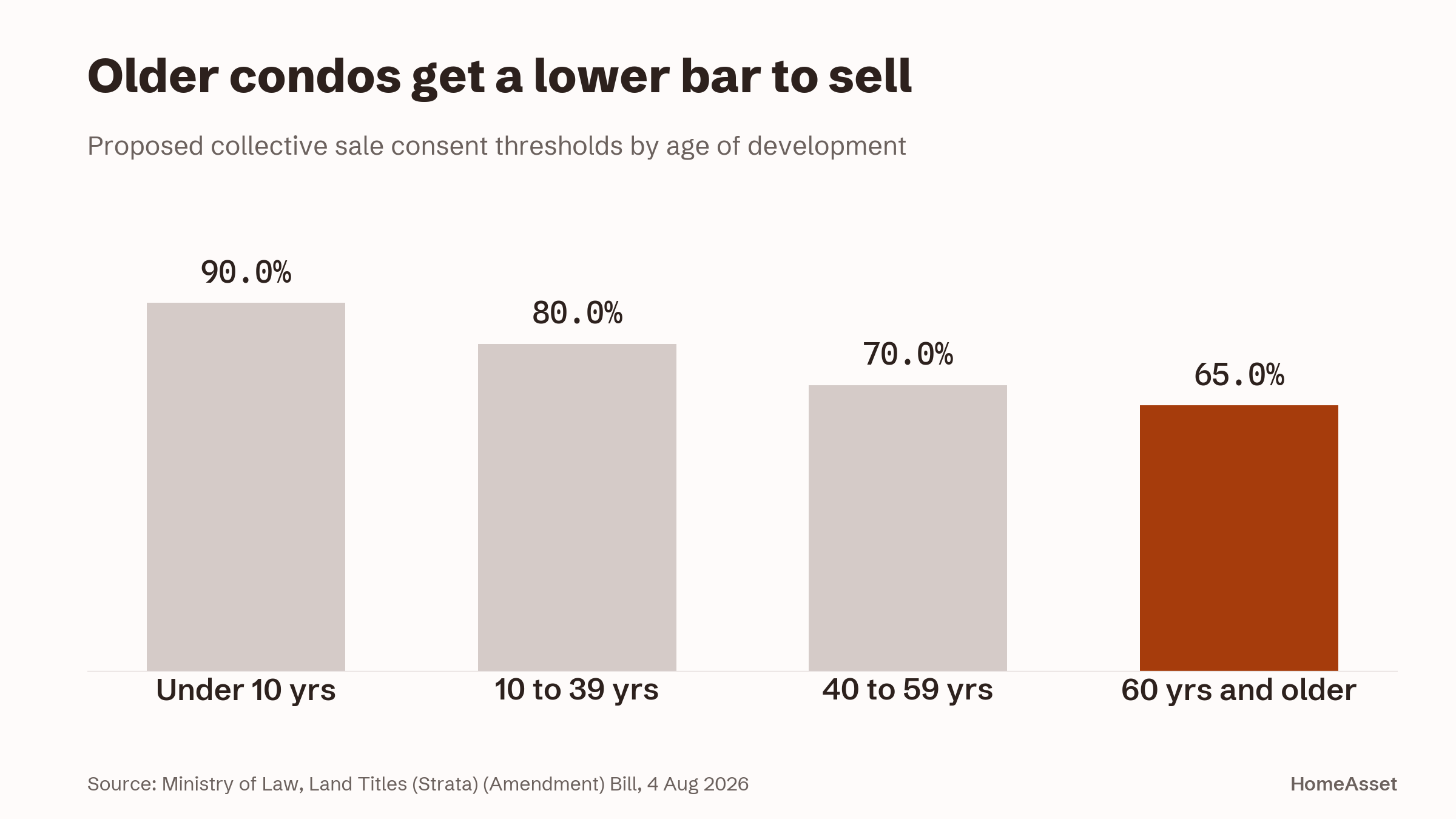 The 90% and 80% thresholds stay. The Bill adds two new bands for older
developments, at 70% and 65%. Source: Ministry of Law
The 90% and 80% thresholds stay. The Bill adds two new bands for older
developments, at 70% and 65%. Source: Ministry of Law
The Bill also brings a category of homes into the regime for the first time: non-strata private developments where owners hold long leases on their flats but not the land under them. Today those estates can only sell if every single owner and the landowner agree. The amendments would allow a majority sale there too, with safeguards for the landowner’s interest.
The other half: harder to start, faster to finish
The lower thresholds come packaged with three changes that cut the other way, aimed at owners who do not want to sell and are tired of living through repeated attempts.
Starting an attempt gets harder. Convening the general meeting that forms a collective sale committee will require signatures from 35% of owners, up from 20% by share value or 25% by unit count today. A small group of en bloc hopefuls can no longer set the process in motion on their own.
Running one gets shorter. Committees will have 6 months to collect signatures for the collective sale agreement, down from 12. MinLaw’s stated aim is to limit the prolonged pressure on owners who have said no.
And failing has a longer cooldown. After a failed attempt, the restriction period before the machinery can restart stretches from 2 years to 3, with higher requisition requirements during that window.
For exercises already in motion, the cutoff is the first signature on the sale agreement. Attempts that have one before the amendments commence stay under the current rules. Committees still gathering signatures at that point can choose to terminate and restart under the new regime, with 7 months to hit the new threshold.
This is the second en bloc lever the government has pulled in a week. On 29 July, developers buying large collective sale sites were given 6 to 7 years to finish and sell out their projects before forfeiting ABSD remission, up from five. That change worked on the demand side, making big sites less risky for developers to buy. This Bill works on the supply side, making it easier for the oldest estates to offer themselves for sale. The Bill goes to a Second Reading at the next available Parliament sitting.
What this means for you
- If you own a unit in a condo past 40, an en bloc outcome just became more possible, in both directions. A sale you support needs 10 to 20 percentage points less consent. A sale you oppose can also proceed without you, though the higher starting bar and shorter windows mean only attempts with real support will get far.
- If you are buying an older condo for the long stay, check the age band it will enter during your ownership. A 55-year-old development you plan to hold for a decade will cross into 65% territory, and redevelopment potential will increasingly be priced into asking prices.
- En bloc hopes still need a buyer. Lower thresholds make more sites available, but last week’s ABSD change exists precisely because developers have been selective. Do not pay a premium for an en bloc story unless the numbers work without it.
- The Bill is not law yet. Details can change at the Second Reading, and the commencement date has not been announced. If you are mid-exercise, where your first signature lands relative to that date decides which rules apply.
Sources
Market commentary dated 5 August 2026. Conditions change; verify figures against the primary sources above before acting. This is general information, not financial advice.