Mega en bloc sites get seven years to sell. Pricing still rules
 By Alvin Ang
Developers who buy a large collective sale site from 29 July get six or seven years to finish building and sell every unit, up from the old five-year clock. It is the clearest signal yet that the government wants the mega en bloc back, and it lands weeks before the biggest test case in years closes its tender.
National Development Minister Chee Hong Tat announced the change at the 11th Singapore Economic Review Conference on 28 July, in the same speech that removed the 15-month wait-out period for private owners buying HDB resale flats.
The mechanics matter here, so a quick refresher. A developer buying residential land pays 40% ABSD upfront. Of that, 5% is gone for good. The other 35% comes back only if the developer starts building within two years, then completes the project and sells every single unit within five years. Miss the deadline, even by one unit, and the 35% is clawed back with interest. On a $1 billion site, that is $400 million paid upfront with $350 million riding on the deadline.
From 29 July, collective sale purchases get more room if the redevelopment is big enough. A new project of 700 to 1,399 homes gets six years to complete and sell out. A project of 1,400 homes or more gets seven. Two strings are attached: the new development must contain at least 1.5 times as many homes as the estate it replaces, and a project on the seven-year track must still have sold at least half its units by the end of year six, or the clawback bites at that point.
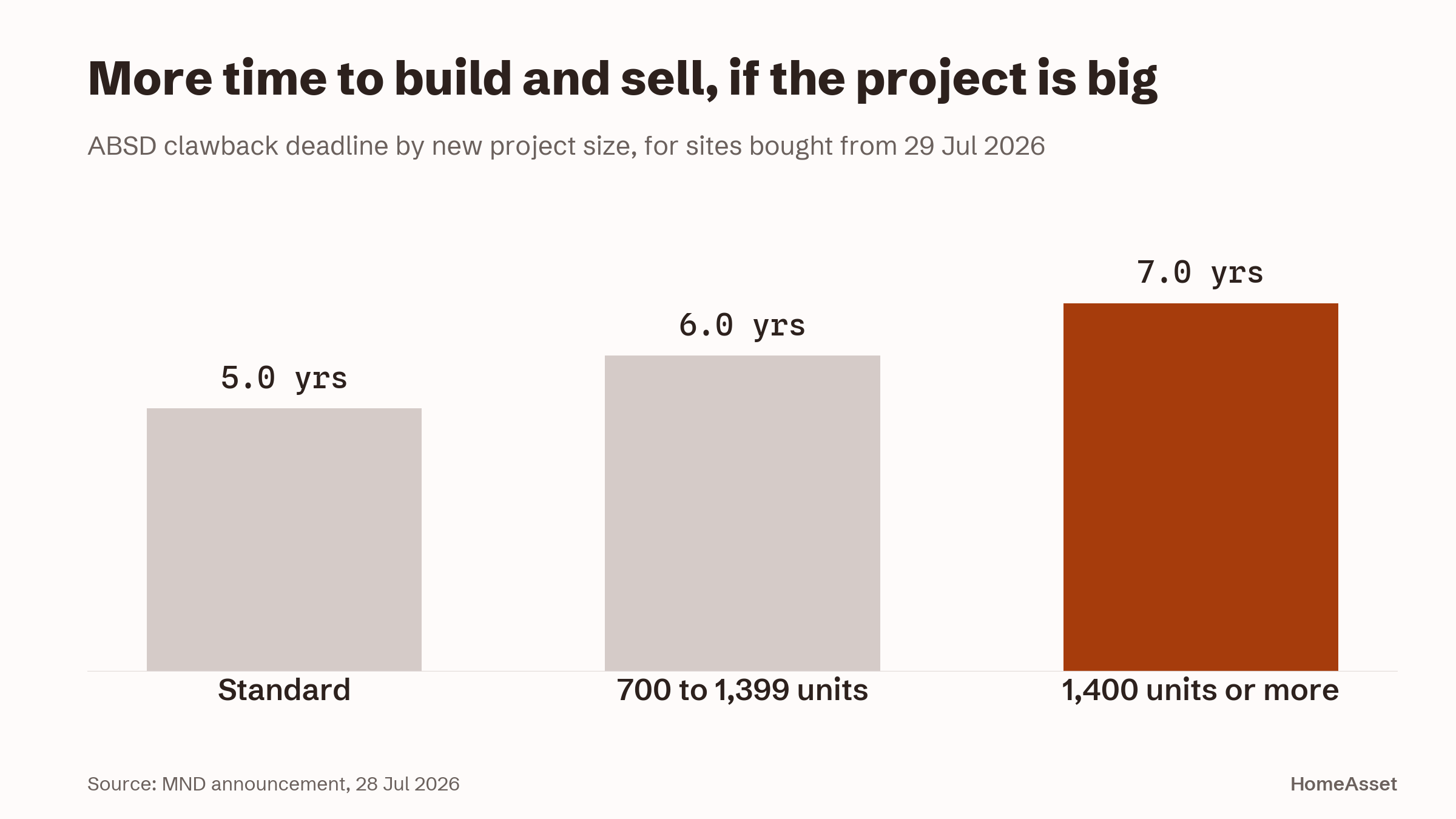 The clock now stretches with project size, for collective sale sites bought from 29 July 2026. Source: MND announcement, 28 Jul 2026. Chart: HomeAsset.
Why the five-year clock froze the market
Developer ABSD arrived with the 2018 cooling measures and has sat at 40% since 2022. A 2,000-unit redevelopment takes longer to build and much longer to sell than a 300-unit one, yet both ran on the same five-year clock. That mismatch priced the biggest sites out of contention: the risk of losing a nine-figure sum to a slow sales tail was simply too high.
A first concession came in March 2025, when eligible large or complex projects could earn six to 12 extra months. It changed little. The money went where developer ABSD does not apply, into commercial and hotel buildings such as Delfi Orchard at $439 million and Concord Hotel and Shopping Mall at $821 million.
Even so, the thaw had begun. A UOL-led group took Thomson View for $810 million, SingHaiyi bought Loyang Valley for $880 million in April, and Kingsford agreed this month to pay $950 million for Tan Boon Liat Building, the largest collective sale in eight years.
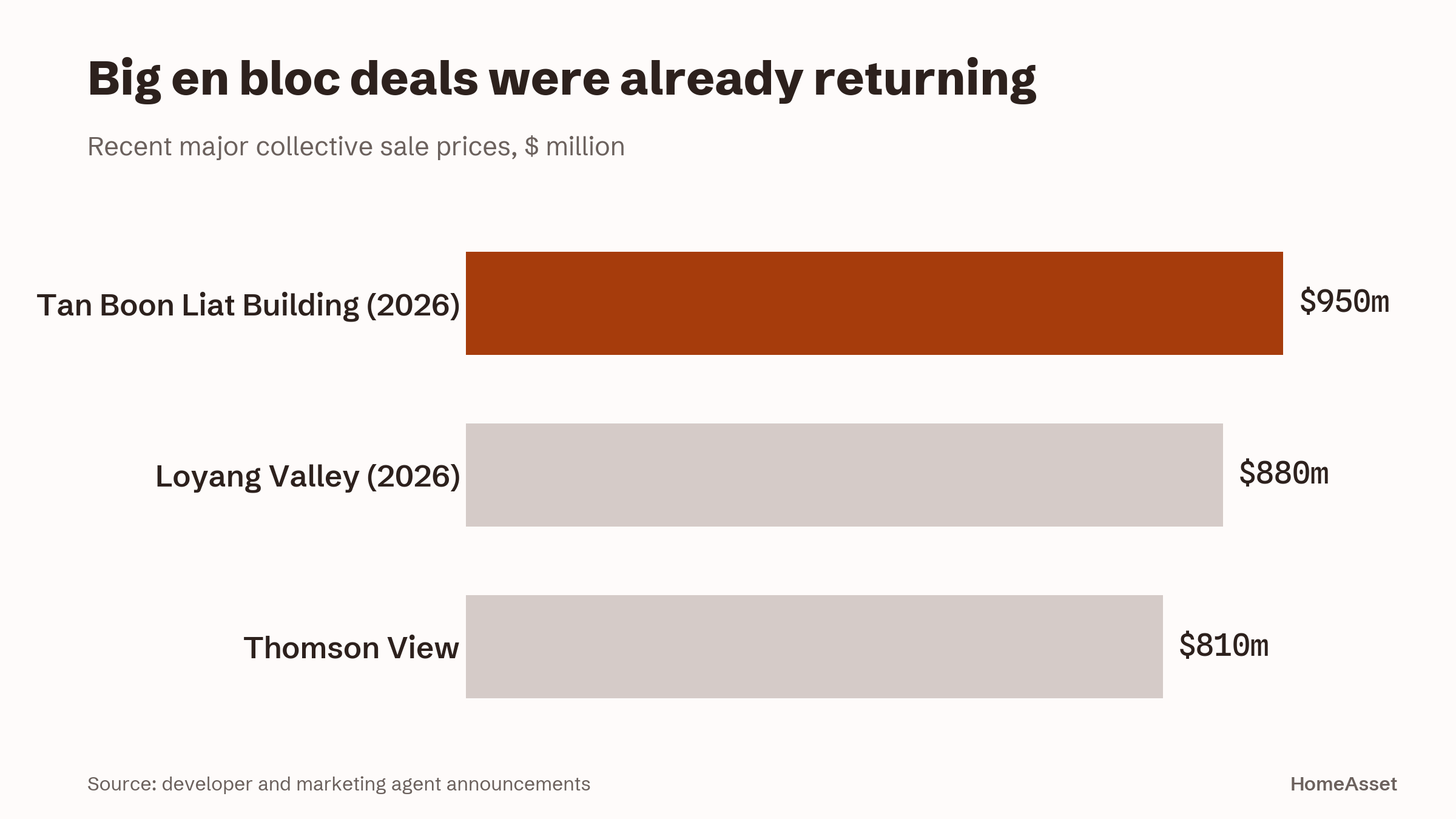 Big collective sales were already coming back before the rule change. Source: developer and marketing agent announcements. Chart: HomeAsset.
What the analysts make of it
The consensus reads the change as targeted rather than sweeping. Knight Frank’s head of research Leonard Tay said the adjustment mainly reduces execution risk for very large redevelopments rather than stimulating the en bloc market broadly, though he expects some developers to take a fresh look at big ageing estates now on the market. Wong Shanting, Newmark’s head of research for Singapore, described it as easing timing pressure without dismantling ABSD discipline, which could reopen the window for older projects in need of renewal.
CBRE’s Tricia Song was the most upbeat: larger sites bring economies of scale during construction, can rejuvenate whole precincts, and would put more new homes, some of them freehold, into mature areas where land rarely surfaces.
The sceptics’ case is about price, not time. Nicholas Mak, chief research officer at Mogul.sg, pointed out that owners’ reserve prices are being pushed up by the cost of their own replacement homes, and that plot ratios on most ageing condos have not moved in more than 25 years, which caps what a developer can build and therefore what it can pay. Tay cautioned that construction costs, financing and achievable selling prices still decide whether a deal works, and the clawback risk has not gone away. Developers also still favour state land: GLS sites offer one seller and clean terms, and CBRE estimates they already supply about 7,500 to 8,000 condo units a year.
The first read on developer appetite comes quickly. People’s Park Centre, one of the largest sites on the market, launched its third collective sale attempt on 15 July at a $1.48 billion guide price, $320 million below its 2022 reserve. Its tender closes on 16 September, the first large one to close under the new timelines.
What this means for you
- If you own a unit in a large, ageing estate, the developer’s maths on your site just improved, but only the timeline part. Reserve price remains the deal-killer, and the estates that transact will be the ones priced to today’s market instead of 2022’s hopes.
- Buyers hunting older resale condos for en bloc potential should note the change helps very large plots most. A project that cannot yield at least 700 new homes, at 1.5 times the current unit count, gets nothing new here.
- For new-launch buyers, more mega redevelopments would eventually mean more new supply in mature and central areas, some of it freehold. That effect arrives years out; it changes nothing about 2026 pricing.
- Watch the People’s Park Centre tender on 16 September. An award there would say more about developer appetite for big sites than any policy statement can.
Sources
Market commentary dated 29 July 2026. Conditions change; verify figures against the primary sources above before acting. This is general information, not financial advice.